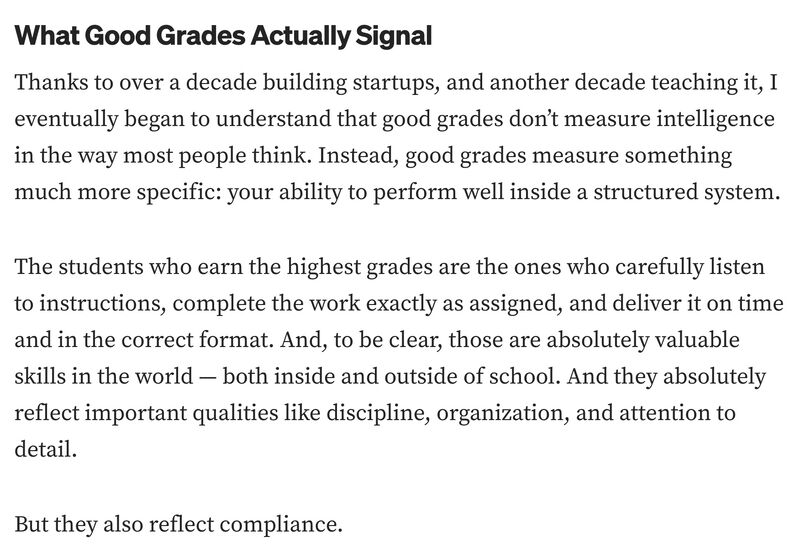
TL;DR — The "startup spirit" has decided that merit doesn't count, that the past doesn't count, that proven skills don't count. What counts is "believing it" and having "the right attitude". It's false as Judas. The cursus honorum — the path of passed exams, measurable results, verifiable signalling — was invented in the West as a rapid heuristic to distinguish thoroughbreds from others. It's not perfect, but it's by far the best starting point. Inverting it is self-harm.
There's a Medium article circulating for some time now, and I found it particularly irritating. It sums up everything that's wrong with the "startup spirit" and why 90% of startup founders and Dan Kennedy-style micro-entrepreneurs are insufferable and delusional.
The article's premise is that in startups and "YEAH!" companies merit doesn't count. Economic and evolutionary signalling doesn't count. The past, who you've been, your real skills don't count. What counts is believing in it tremendously and having "the right attitude". Whatever that means.
This idea, popularised by Musk (now burnt by ketamine) and by many Italian fluffmagnates, is a suicidal concept. Literally.
What cursus honorum is (and why we invented it)
The cursus honorum was born in ancient Rome as the ordered sequence of public offices a citizen had to go through to reach the consulate. Quaestor, aedile, praetor, consul. Each step required a minimum age, years of service in the previous office, demonstrated results.
It wasn't an aristocratic whim. It was a social heuristic: in a complex world, how do you quickly figure out if a person can handle function X? One answer is: look at what they've done before. If they've passed smaller functions without disasters, they probably can handle a bigger one. If they started right at the big one, probably not.
The West extended this principle to almost every civil domain: school, university, professional registers, career paths. It's an imperfect system — clearly many of your brilliant classmates ended up in mediocrity, and many mediocre students exploded professionally — but it's the best we have as a starting point.
The delirium of inversion
Going as far as claiming that "those who did well at school are terrible at business and in startups" implies a post-reality. It's the inversion of how the world and things work.
It implies taking the worst ones and deciding that, a priori, they should be the most suited and those who will have the most success. It's false as Judas. It's false empirically, statistically, historically.
Not everything in school is rote evaluation. There is also analysis and accounting of fluid intelligence — the ability to solve new problems, to adapt, to synthesise. And — this is crucial — you often get excellent grades even if you're TERRIBLE at executing orders, but you're sufficiently capable of:
- Creating collaboration strategies with classmates.
- Making alliances without getting caught.
- Being gifted at creating connections.
- Getting out of crisis situations with problem-solving.
I've just described myself and many others. I'm the worst at following orders. Yet my grades have never been low. In fact I function better as an entrepreneur than as an employee, despite a decent career as an employee.
Conflating two things
There's a conceptual confusion that the champions of "startup spirit" systematically commit. They mix two different claims:
True claim: "School grades don't predict entrepreneurial success 100%." True. It's a partial indicator, not a proof.
False claim (they stick on top of it): "So those who did well at school are worse than the others." Doesn't follow. Never followed. On the contrary: all serious studies on long-term economic success show that education and school performance are positively correlated with professional success, including entrepreneurial success. Imperfect correlation, but positive.
The rhetorical trick of inversion serves a simple purpose: giving dignity to those who haven't signalled. To sell you the course, to make you believe that even you, without having proven anything, can. An inversion that sells because it consoles.
The Italian and Dubai fluff-guru industry
Here's the practical point: why is this delirium so widespread? Because it serves a specific category.
Italian and Dubai fluff-gurus are all people who did poorly at school. Nothing wrong in itself — everyone has their own pace, school isn't for everyone. But after school they didn't do alternative signalling either: no real companies, no positive P&L, no clients with case studies, no measurable careers. Just "I made it because you didn't believe in yourself enough."
They need the cultural inversion to survive. They have no alternatives except swindling people, or they go under. Cursus honorum society would have left them on the bench. "Attitude" society gives them a microphone.
And that's why I don't work anymore with classic startup people and that world. It's masturbatory and delusional. It feeds an industry that produces nothing except storytelling, and it hurts the real economic fabric — the one of real companies, with real products, with real employees.
What to do, concretely
If you have to hire someone, choose a collaborator, trust a professional, always start from those who have done excellent signalling. It's not a guarantee, it's a probability.
High grades as a young person. Degree from a good university. Early jobs in companies that are hard to enter. Measurable results in the career. Publications, recognitions, things verifiable by third parties.
If instead you have in front of you someone whose CV only shows "founder" of companies you've never heard of, courses given (not attended), motivational LinkedIn posts, and the word "mindset" appears more than five times — high probability of wasted time. Not certainty, probability.
The world has 2,500 years of history on how to tell apart those who can from those who can't. Ignoring that history for the storytelling of the last ten years is a choice. An expensive choice.
Continue reading
- How to spot a marketing fake guru: the warning signs
- The great passive income lie: 5 myths destroyed one by one
- The three big illusions of making money online