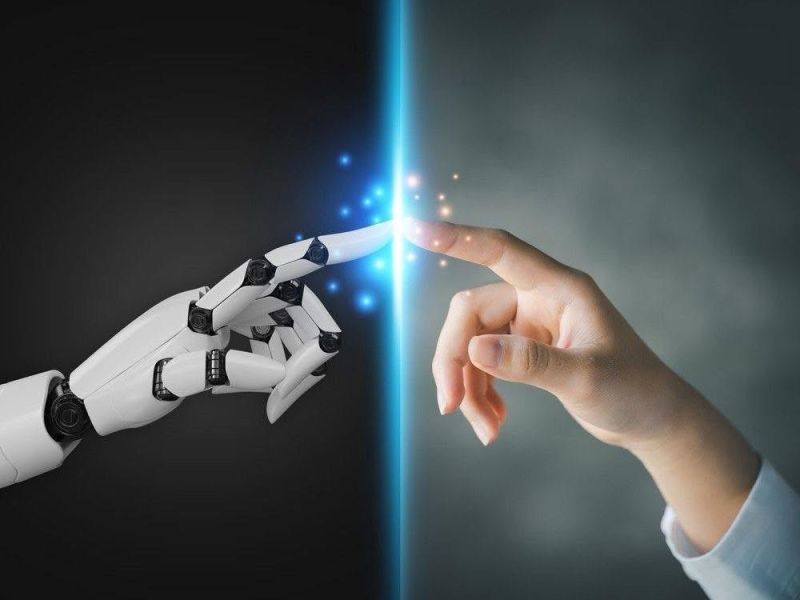
TL;DR — I've figured out an empirical rule about AI's healthy role in our lives. AI can be extraordinary at lowering the friction toward other people and professionals. This must be its role — not the replacement of the human, but the buffer that fills the infinite frictions capitalism puts between us and the people we need. It's fine to vent at 3am if you have a therapist on Tuesday. It's fine for a marketing idea if you then rely on a serious professional.
After months of using AI and having my teams use it, testing models, watching the good and the bad it produces on people, I've arrived at a generalisation that seems to hold. The only healthy role, I mean. Everything else — replacing humans, becoming daily company, substituting for real relationships — is crooked, even if today it's crooked in a fashionable way.
Here's the empirical rule: AI can be extraordinary at lowering friction toward other people and professionals. This must be its role. Nothing else. Nothing less, nothing more.
What I mean by "friction"
Society — especially the advanced capitalist one we live in — has infinite frictions that activate precisely when you'd need people. Concrete examples:
- It's 3am and acute anxiety hits you. Your therapist is on Tuesday.
- You get blood test results Friday night. The specialist has no slots until mid-month.
- You have a marketing idea that excites you at 10pm on Saturday. Your agency chat is frozen until Monday.
- You're on a business trip alone in a new city. Friends are 1,400 km away, and at 9pm they don't answer.
These frictions are real. They're nobody's fault. A professional can't and shouldn't be up 24/7 for you. A friend has their own life. A doctor has hours. An agency closes at 7pm. Yet the need comes when it comes, and it's not always patient.
Three examples, three healthy uses
Example 1: 3am anxiety. It's fine if at 3am you wake up in a vortex of loneliness and talk to an AI for twenty minutes, to vent, to name what you feel, to not go crazy alone. As long as on Tuesday you actually go to your therapist. And this week you make an effort to see a friend.
Example 2: the business idea. It's fine if you have a marketing idea at 10pm on Saturday and you develop it with an AI to see if it holds, to outline it, to anticipate objections. As long as on Monday you turn to a real professional to make it something serious. An AI doesn't know you, doesn't know your market, has no responsibility for the outcome. An agency does.
Example 3: medical tests. It's fine if you check the trend of your blood test results over the years with an AI, if you're afraid of something, if you want to understand what to ask the doctor. As long as next month you actually go to the specialist. Don't self-diagnose with ChatGPT. Don't do AI therapy.
Why "AI only" is a trap
The problem with AI as a total replacement is not the quality of the answer — often it's surprisingly good. The problem is structural:
1. AI doesn't have long-term memory of you. Even systems with memory are closed boxes: they don't really know you. They don't know you're still shaken by the 2024 breakup, that your father had that issue, that you tend to lie when stressed. A professional who follows you over time does.
2. AI has no skin in the game. If it gives you bad advice, it loses nothing. No professional liability, no licence suspension, no damages. Your specialist risks a career if they give you a risky opinion. AI risks zero. This asymmetry matters.
3. AI doesn't replace presence. There are things — a hand on the shoulder, a look that recognises you, a shared silence — that a language model doesn't replicate. And the lack of presence, over time, is a nutritional deficit of the psyche.
The rule in practice
The useful question, before opening the AI chat, is this: am I using AI to get closer to a human, or to avoid having to look for a human?
If AI is a buffer — it eases my urgency until I reach the human I need — fine. If AI is a surrogate — I no longer look for the human because AI is enough — not fine. It's the same difference between chewing gum when you're hungry while travelling, and chewing gum instead of eating.
Context matters
One more thing, to be honest: AI works better in some areas than others, and its buffer role changes accordingly.
- Brainstorming, outlining, first drafts: AI is extremely efficient. The buffer is short because you then present it to a human.
- Mental health: buffer of minutes or hours, never weeks. Therapy requires an ongoing relationship a model doesn't build.
- Physical health: informational buffer (understanding what to ask, preparing for the visit). Never diagnostic or therapeutic.
- Business consulting: buffer to organise ideas. Never for structural decisions — those require skin in the game.
- Personal relationships: buffer to understand what you feel. Never as a substitute for friends, partner, family.
Conclusion
AI is the biggest social shock absorber of our era. You use it to soften the blow when the system doesn't respond to you in time. But if you start living inside it, you stop asking the system to improve — and the system stops improving.
Act as buffer. Seek the human. Repeat.